Publications
19- AlQahtani, Yahya, Özaydın, S., Chatzaras, Vasileios, Rey, Patrice F., Passos, T. (2025). ``Why Does the Broken Hill Deposit Sit in Resistive Crust? Magnetotelluric Evidence for Metamorphic Decoupling of a World‐Class Mineral System”, Journal of Geophysical Research:Solid Earth, 131, e2026JB035666. https://doi.org/10.1029/2026JB035666.
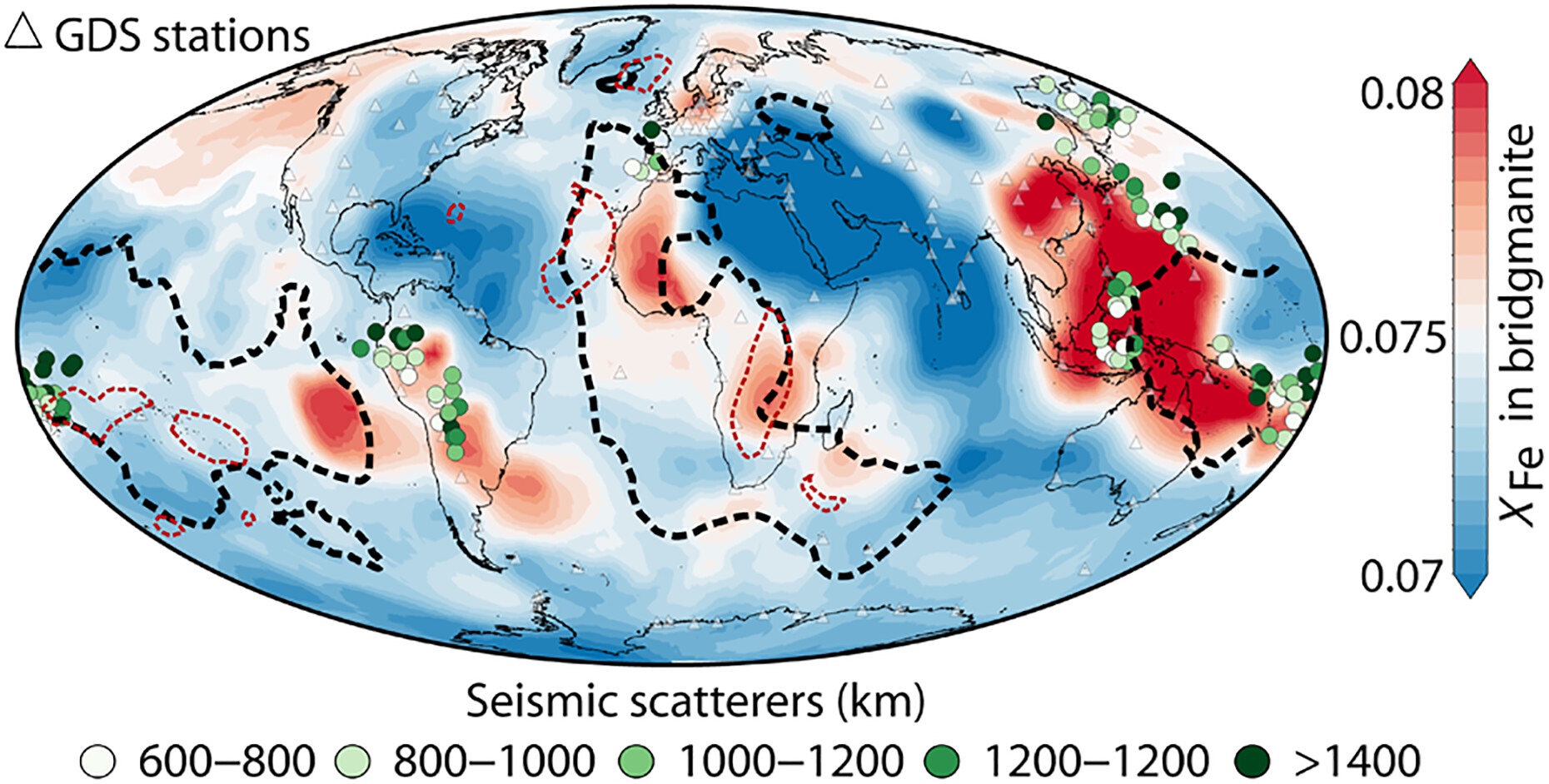
18- Han, Kui, Özaydın, S., Fei, Hongzhan, Man, Lianjie, Wang, Fei, Chanyshev, Artem, Withers, Anthony C., Grayver, Alexander, Katsura, Tomoo (2026). ``Lower mantle iron heterogeneity indicated by electrical conductivity”, Science Advances, 12(17), https://doi.org/10.1126/sciadv.aec7875.
We measured how the electrical conductivity of bridgmanite, the most abundant mineral in Earth’s lower mantle, changes with iron content and temperature, finding that conductivity rises sharply with more iron while temperature has little effect. Using our petrophysical toolkit pide, we then inverted real geomagnetic observation models directly into estimates of how iron content varies across the lower mantle. This gives us a direct link between the patchy conductivity anomalies long seen in geomagnetic data and actual compositional differences deep inside the Earth, offering a new way to map the chemistry of a region that makes up more than half the planet’s volume.
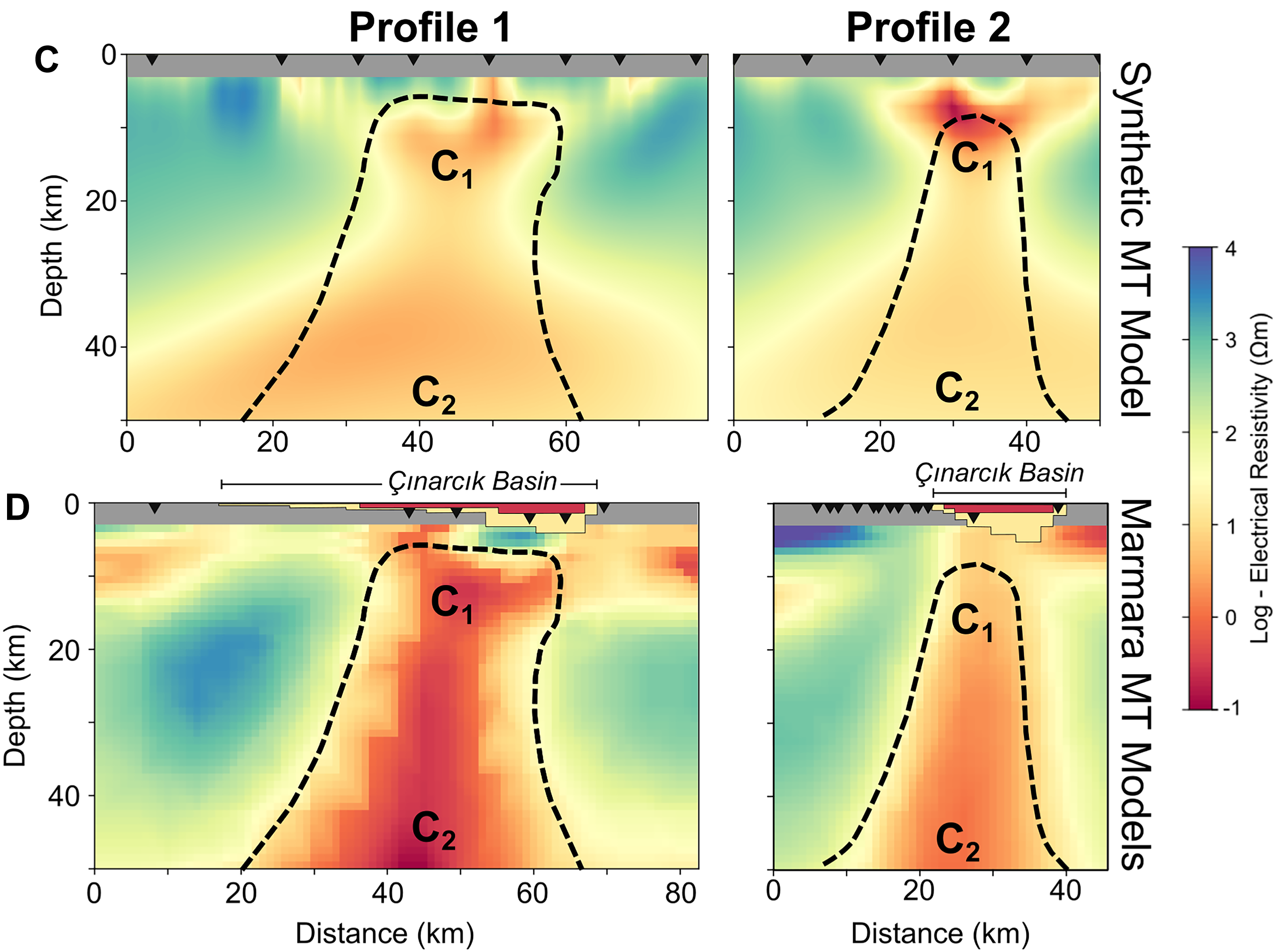
17- Özaydın, S., Rey, P., & Chatzaras, V. (2025). Strain controls the electrical conductivity distribution in the lithosphere. Geology, https://doi.org/10.1130/G53957.1.
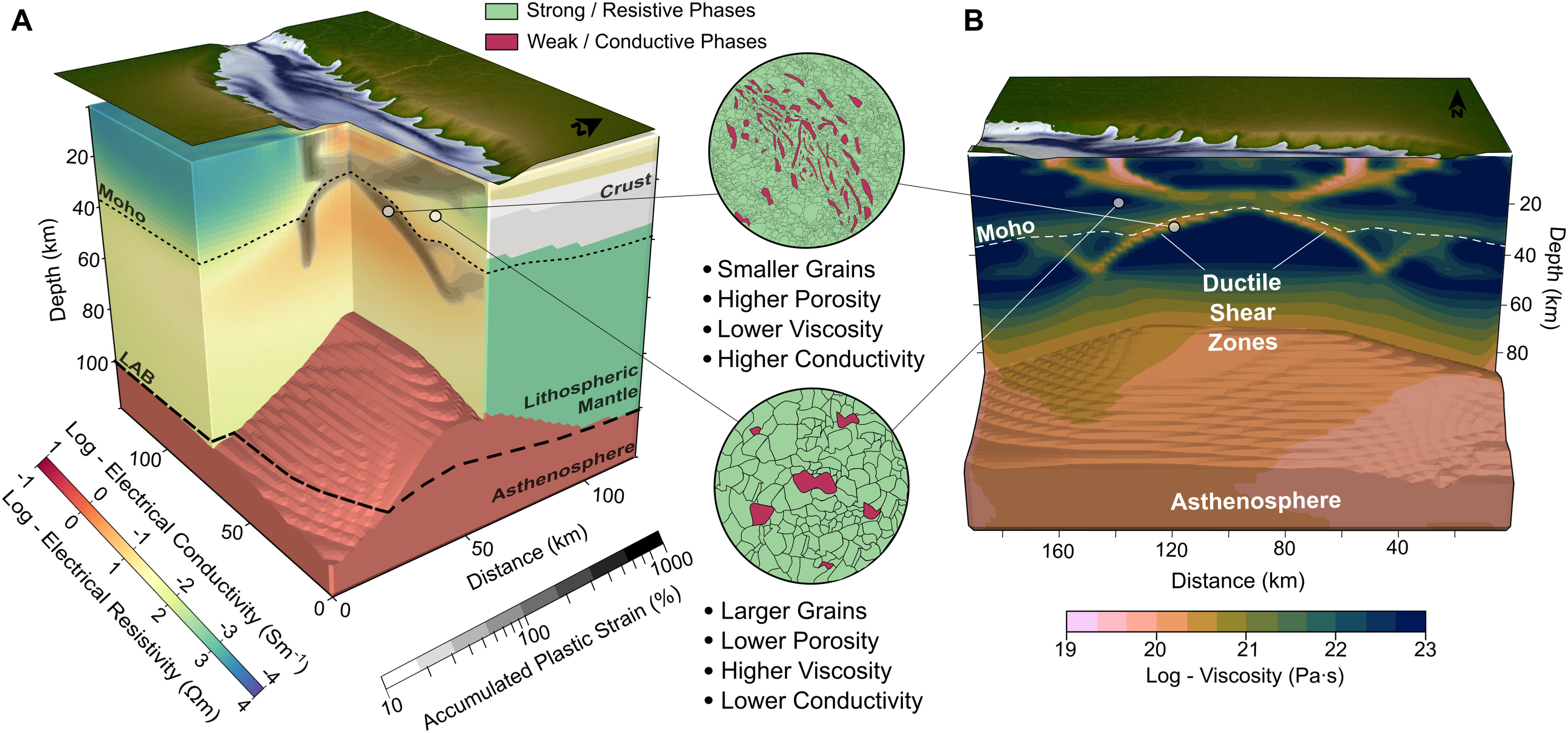
We combined 3D tectonic deformation simulations with laboratory rock conductivity measurements to test whether strain controls where conductive anomalies form in the lithosphere. Applying this to a pull-apart basin setting, we found that our synthetic model closely matches real magnetotelluric data from the Marmara Sea in Turkey, a region shaped by the North Anatolian Fault.
This agreement suggests that many conductivity anomalies seen deep underground are essentially scars left behind by past deformation, since strain helps fluids and melts connect into conductive networks along fault zones. The work gives geophysicists a physical basis for interpreting these signals, rather than relying on qualitative assumptions about their origin.
16- Singh, U., Özaydın, S., Chatzaras, V., & Rey, P. (2025). SAnTex: A Python-based Library for Seismic Anisotropy Calculation. Journal of Open Source Software, 10(110), 6886, https://doi.org/10.21105/joss.06886.
Access the source code from here: https://github.com/utpal-singh/SAnTex
SAnTex is a Python library which calculates the full elastic tensor of rocks from modal mineral composition, crystallographic orientation, and a crystal stiffness tensor catalogue that accounts for the dependency of elasticity with pressure and temperature.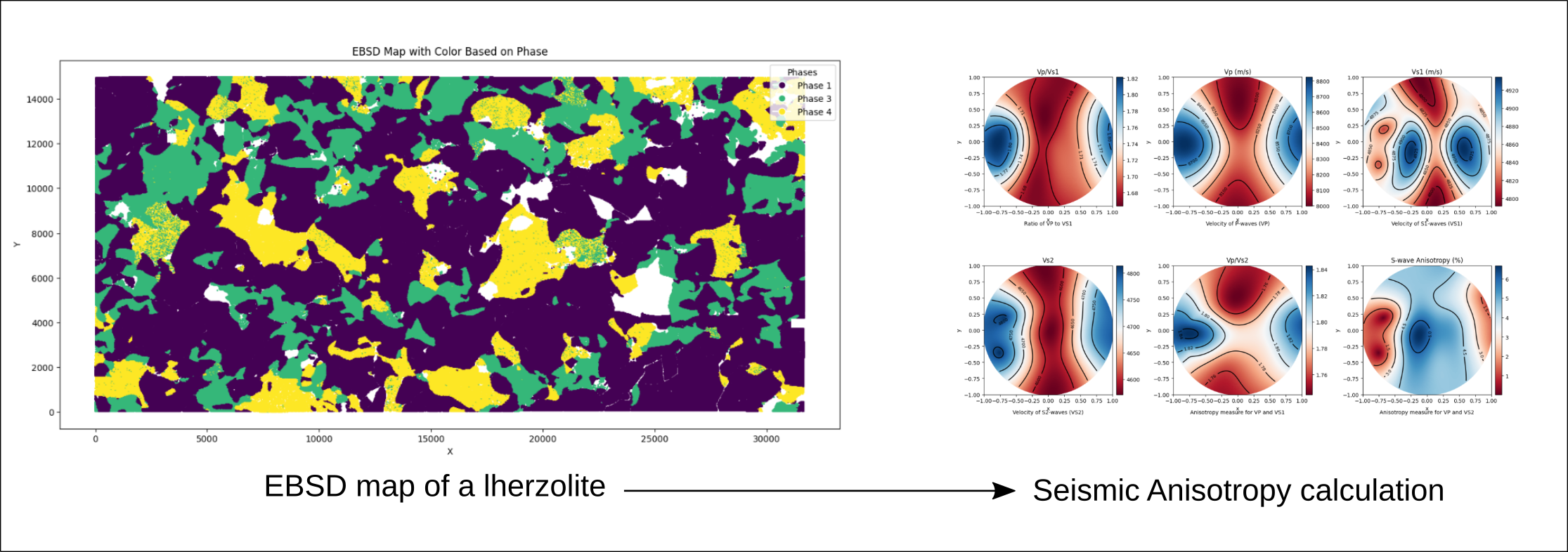
15- Özaydın, S., Li, L., Singh, U., Rey, P. F., & Manassero, M. C. (2025). pide: Petrophysical Interpretation tools for geoDynamic Exploration. Journal of Open Source Software, 10(105), 7021 https://doi.org/10.21105/joss.07021.
Access the source code from here: https://github.com/sinanozaydin/pide
pide is a Python3 library for calculating geophysical parameters (e.g., electrical conductivity, seismic velocity), employing the results from experimental petrology, mineral/rock physics, and thermomechanical modelling studies. pide can calculate the theoretical electrical conductivity of any earth material that exists in the literature. pide can also calculate seismic velocity utilising the external 'sister' library `santex`. Using these theoretical calculations, users can utilise inversion modules to decode geophysical anomalies compositionally or convert thermomechanical models into geophysical observables. With a given spatial mapping of earth materials, which can preferentially be loaded from a thermomechanical model, pide can be used to build synthetic electrical conductivity and seismic velocity models and generate gravity and magnetic anomalies. Moreover, it is built as a modular tool, so users can easily build their functions.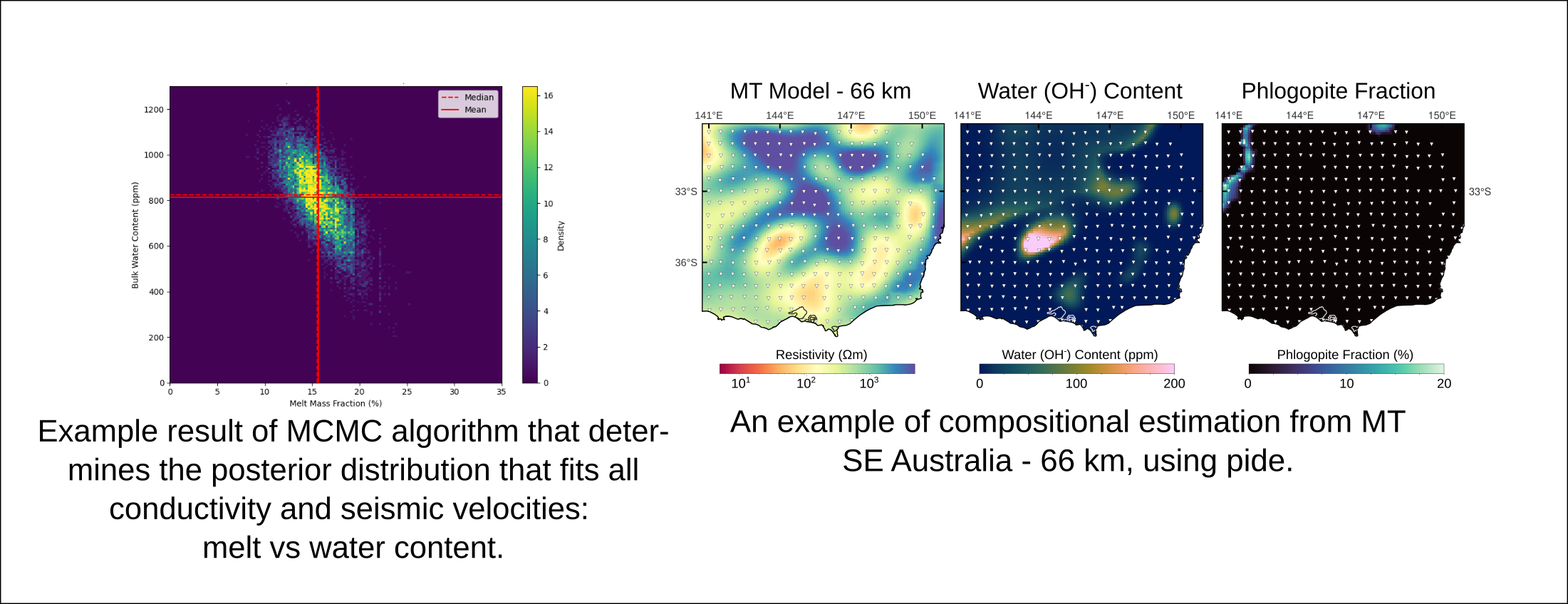
14- Manassero, M. C., Özaydın, S., Afonso, J. C., Shea, J. J., Ezad, I. S., Kirkby, A., … & Czarnota, K. (2024). Lithospheric structure and melting processes in southeast Australia: new constraints from joint probabilistic inversions of 3D magnetotelluric and seismic data. Journal of Geophysical Research: Solid Earth, 129(3), e2023JB028257, https://doi.org/10.1029/2023JB028257.
13- Özaydın, S., Selway, K., Foley, S. F., Ezad, I. S., Griffin, W. L., Tarits, P. S., & Hautot, S. (2024). Role of metasomatism in the development of the East African Rift at the northern Tanzanian divergence: Insights from 3D magnetotelluric modeling. Geochemistry, Geophysics, Geosystems, 25(1), e2023GC011191, https://doi.org/10.1029/2023GC011191.
12- Selway, K., Özaydın, S., & Payne, J. (2024). Metasomatism and depletion of the southern Gawler Craton from combined mantle xenocryst and AusLAMP magnetotelluric data. Exploration Geophysics, 55(5), 602-616 https://doi.org/10.1080/08123985.2023.2282711.
11- Han, K., Guo, X., Wang, X., Zhang, J., Özaydın, S., Li, D., & Clark, S. M. (2023). The electrical conductivity of granite: The role of hydrous accessory minerals and the structure water in major minerals. Tectonophysics, 856, 229857, https://doi.org/10.1016/j.tecto.2023.229857.
10- Wieser, P. E., Petrelli, M., Lubbers, J., Wieser, E., Özaydın, S., Kent, A. J. R., & Till, C. B. (2022). Thermobar: An open-source Python3 tool for thermobarometry and hygrometry. Volcanica, 5(2), 349–384, https://doi.org/10.30909/vol.05.02.349384.
9- Özaydın, S., & Selway, K. (2022). The relationship between kimberlitic magmatism and electrical conductivity anomalies in the mantle. Geophysical Research Letters, 49(18), e2022GL099661, https://doi.org/10.1029/2022GL099661.
8- Özaydın, S., Selway, K., Griffin, W. L., & Moorkamp, M. (2022). Probing the southern African lithosphere with magnetotellurics: 2. Linking electrical conductivity, composition, and tectonomagmatic evolution. Journal of Geophysical Research: Solid Earth, 127(3), e2021JB023105, https://doi.org/10.1029/2021JB023105.
7- Moorkamp, M., Özaydın, S., Selway, K., & Jones, A. G. (2022). Probing the southern African lithosphere with magnetotellurics—Part I: Model construction. Journal of Geophysical Research: Solid Earth, 127(3), e2021JB023117, https://doi.org/10.1029/2021JB023117.
6- Özaydın, S., Selway, K., & Griffin, W. L. (2021). Are xenoliths from southwestern Kaapvaal Craton representative of the broader mantle? Constraints from magnetotelluric modeling. Geophysical Research Letters, 48(11), e2021GL092570, https://doi.org/10.1029/2021GL092570.
5- Özaydın, S., & Selway, K. (2020). MATE: An analysis tool for the interpretation of magnetotelluric models of the mantle. Geochemistry, Geophysics, Geosystems, 21(9), e2020GC009126, https://doi.org/10.1029/2020gc009126.
4- Selway, K., O’Donnell, J. P., & Özaydın, S., (2019). Upper mantle melt distribution from petrologically constrained magnetotellurics. Geochemistry, Geophysics, Geosystems, 20(7), 3328-3346, https://doi.org/10.1029/2019GC008227.
3- Tank, S. B., Özaydın, S., & Karaş, M. (2018). Revealing the electrical properties of a gneiss dome using three-dimensional magnetotellurics: Burial and exhumation cycles associated with faulting in Central Anatolia, Turkey. Physics of the Earth and Planetary Interiors, 283, 26-37, https://doi.org/10.1016/j.pepi.2018.07.010.
2- Özaydın, S., Tank, S. B., & Karaş, M. (2018). Electrical resistivity structure at the North-Central Turkey inferred from three-dimensional magnetotellurics. Earth, Planets and Space, 70(1), 49, https://doi.org/10.1186/s40623-018-0818-4.
1- Karaş, M., Tank, S. B., & Özaydın, S., (2017). Electrical conductivity of a locked fault: investigation of the Ganos segment of the North Anatolian Fault using three-dimensional magnetotellurics. Earth, Planets and Space, 69(1), 107, https://doi.org/10.1186/s40623-017-0695-2.